Showing posts with label education. Show all posts

Wednesday, May 27, 2015

Baker’s “Compromise” Tax Hike for Schools Plan Still Misses


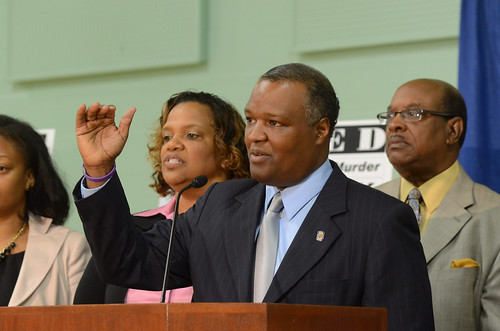
County Executive Baker. Image by MDGovpics on flickr.
In a hastily arranged press conference earlier today, Prince George’s County Executive Rushern Baker finally threw in the towel on his ill-conceived and politically doomed plan to dramatically raise property and other local taxes to fund a $133 million increase in the public schools budget.

But in a final “Hail Mary” effort less than 24 hours before the scheduled County Council vote, he’s now proposing a “compromise” plan for a $65 million increase.

The problem for the county executive is that simply cutting a bad plan in half does not transform it into a good plan.

Claiming that he had heard the public’s voices in opposition to his original request over the last several weeks, Baker essentially adopted the purported compromise proposal that the county Chamber of Commerce had floated last week—the same one he flatly panned at the time. In addition, Baker said he’d support a sunset of any tax increases in 2020, after the projected education revenues from the new MGM Casino at National Harbor had a chance to come in.

Baker’s latest proposal came with no financial specifics as to how he envisions the $65 million infusion being allocated—and Baker’s spokesperson did not provide a response when asked for specific figures. However, the county executive did indicate that teacher pay increases, pre-kindergarten expansion, and school-based budgeting should remain priorities. He also claims that anything less than $65 million would not “move the needle.”

Without providing specific numbers at this late stage, Baker’s proposal simply cannot be taken as a serious effort to urge new ideas to the council. Instead, the county executive’s proposal seems designed to salvage a partial victory out of a proposal that was headed for certain defeat tomorrow.

The CEO of Prince George’s County Public Schools (PGCPS), Dr. Kevin Maxwell, did not appear with Baker at his press conference today and offered no comment in response to his eleventh-hour revised proposal.

Earlier this week, I suggested that the council should adopt a modified version of Dr. Maxwell’s original $1.84 billion budget request. I still urge the council to take that course tomorrow, for all the reasons previously stated. At the very least, Dr. Maxwell’s budget was well thought out and contains specific numbers—which is way more than can be said of the county executive’s plan.

Monday, May 25, 2015

Prince George’s Should Adopt the School System CEO’s Original Budget


CEO Dr. Kevin Maxwell. Image from PGCPS.
This past December—before Prince George’s County Executive Rushern Baker hatched his hare-brained idea to raise the county’s already-too-high local taxes through the roof—the public schools CEO, Dr. Kevin Maxwell, requested a $1.84 billion budget for FY2016.

Everyone agreed that Dr. Maxwell’s budget would allow the schools to continue making progress, as they had been doing over the previous year under his leadership. This is the budget that, with some modifications, the County Council should adopt this week.

Much of the debate and discussion over the past two months has centered on the revised $1.93 billion budget that Prince George’s County Public Schools (PGCPS) and the county executive proposed in March. This revised proposal would increase the county’s tax-funded contribution to the school system by $133 million and would require a 15.6% increase in real property tax rates and a 50% increase in cell phone tax rates, among other tax increases. Baker would use a state law loophole to get around the county charter-imposed property tax cap known as TRIM, which has been in place since 1978.

Even after weeks of town halls and community forums, the public and the county council remain skeptical about Baker’s tax-hike plan to fund the revised PGCPS budget proposal. A 2014 state audit of PGCPS’s financial practices noted serious concerns with the system’s financial controls, accountability practices, and cost efficiency strategies. Several council members have called for a full and independent performance audit of PGCPS’s practices, but that won’t happen until at least a year from now.

No one on the council has voiced support for Baker’s schools plan, although some appear willing to consider a modest property tax increase of about 3%. The county Chamber of Commerce floated a proposed compromise to cut Baker’s tax increase in half, to about 8%, but the county executive shot down that plan.

The council is scheduled to adopt the FY2016 budget on Thursday, May 28, and council members are reportedly still trying to craft a final draft. But there’s no need to reinvent the wheel as far as PGCPS is concerned, because the budget that Dr. Maxwell originally proposed in December gets it largely right.

Dr. Maxwell’s Budget Will Allow PGCPS to Continue Making Progress

Since Dr. Maxwell took over as CEO of PGCPS in the 2013-14 school year, enrollment has grown, graduation rates have increased, and promotion rates have improved. When he released his proposed FY2016 budget in December, Dr. Maxwell stated that it “continues the progress we have made, while recognizing that fiscal uncertainties do exist.”

The CEO’s budget proposed a 2.5% increase over the FY2015 budget of $1.8 billion and included a $53.5 million increase in the county tax contribution. $14.3 million of that amount was required by increased enrollment coupled with state law-imposed “Maintenance of Effort” (MOE) requirements, which dictate that school systems cannot backtrack on per-pupil expenditure levels from year to year.

Image from Global Partnership for Education on Flickr
The remaining $39.2 million of Dr. Maxwell’s proposed budget increase was designed to fund certain priorities in his strategic plan, including expanded pre-kindergarten programs, additional reading specialists, and expansion of high-demand programs like language immersion, International Baccalaureate, and Montessori.

In the December 12, 2014, news release announcing Dr. Maxwell’s requested budget, Board of Education chair Dr. Segun Eubanks said, “Dr. Maxwell has proposed an ambitious budget to move our system forward.” Similarly, county executive Baker lauded Dr. Maxwell’s proposal as “prudent and pragmatic,” noting that it “appears to fund priorities and invests in programs that will attract families to PGCPS.”

In other words, everyone agreed more than five months ago that Dr. Maxwell’s originally proposed FY2016 budget was sound and that it would move PGCPS forward.

Dr. Maxwell’s Budget Comports With the County Charter and TRIM

Being a longtime Prince George’s resident and having worked in the PGCPS system previously, Dr. Maxwell was fully cognizant of the property tax caps imposed by TRIM. He was also aware that the county charter required any increase in property taxes to be approved by the voters in a referendum. Thus, Dr. Maxwell crafted a budget with those principles in mind.

In 2012, the Maryland legislature passed a state law (SB 848) that allows counties to exceed charter-imposed property tax caps to fund education programs. However, this law was designed to ensure that counties could meet their MOE requirements (as discussed above) in the unusual circumstance where their property tax caps would not otherwise allow them to do so.

Prince George’s MOE requirement for FY2016 would only necessitate an increase of $14.3 million in the PGCPS budget, which the county could easily do without raising tax rates. County executive Baker’s proposal, by contrast, seeks to use SB 848 to effect a discretionary budget increase of more than nine times that required by MOE. This smacks of political gamesmanship and abuse, and only exacerbates the well-earned trust deficit that county officials have sown with their citizens through years of corrupt practices.

If the county executive wants to overturn TRIM and the charter requirement for referendum approval of taxing increases, he should make his case with the citizens and propose the appropriate charter amendments to be voted on in an election. What he shouldn’t do is misuse a well-intentioned piece of emergency state legislation to do an end-run around the people who put him in office.

The Council Should Fund Some Additional Student-Supportive Items

Dr. Maxwell’s initial budget request included a $39 million reserve for “negotiated compensation improvements,” presumably for teachers. However, it did not include approximately $9 million in additional funding for several later-proposed items relating to the “Safe and Supportive Environments” and “Family and Community Engagement” prongs of his strategic plan. Dr. Maxwell’s budget also did not include the approximately $2 million in additional funding that would be needed to fully fund the pre-kindergarten expansion. Instead of fully funding the $39 million teacher compensation reserve, the County Council should modify Dr. Maxwell’s budget request to include the $11 million for those missing items.

Image by naught_facility on Flickr.
Dr. Maxwell has made a compelling case over the past couple of months for the need to establish a second shift for maintenance workers and purchase additional supplies, to allow the school system to address several deferred maintenance issues more quickly. He’s also made impassioned and convincing arguments for including additional funding for a universal free breakfast program, parent advocates, and translation services, among other items. And the importance of pre-kindergarten programs can hardly be doubted.

In contrast, Dr. Maxwell’s arguments for enhanced teacher compensation fall quite flat and, in some respects, are plainly disingenuous. The average teacher compensation in PGCPS is already the fourth- or fifth-highest in Maryland, behind Montgomery, Calvert, and Howard counties, and sometimes Baltimore City. PGCPS also far exceeds the average compensation rates in Virginia and nationally.

Contrary to Dr. Maxwell’s stump-speech arguments during the recent town hall forums, PGCPS is not losing a high number of teachers to higher-paying school districts like Montgomery County. In fact, of the 2,871 teachers who left PGCPS between 2010-2013 (the most recent three years for which attrition statistics are available), only 75 (or 2.6%) left for higher-paying school districts in Maryland, and only 48 of those (or 1.7%) went to Montgomery County. (PGCPS officials refused repeated requests to provide data on the number of teachers, if any, who left for higher-paying jobs in DC or Virginia.)

The remaining $28 million that Dr. Maxwell proposed for reserve teacher compensation improvements should be used to offset the $20 million reduction in state funding to PGCPS resulting from Governor Larry Hogan’s refusal to fully fund the Geographic Cost of Education Index (GCEI) formula and/or to reduce or eliminate the need for furloughs in other part of county government.

Bottom line: there is no need to raise local taxes to ensure adequate funding for the Prince George’s County Public Schools. The county council should instead fund the FY2016 budget that Dr. Maxwell originally requested this past December, with slight modifications to ensure adequate funding for safe and supportive schools and family and community engagement.

UPDATE (05/26/2014 11:00 pm): Several people have contacted me offline and asked for a clearer breakdown of the modifications to Dr. Maxwell's budget that I'm suggesting in this blog. I've posted a marked-up document HERE that provides those figures.
Thursday, April 9, 2015

Prince George's Doesn't Need Higher Taxes to Fund Its Schools


Prince George’s county executive Rushern Baker’s recent proposal to raise the county’s base real property tax rate by 16% has created quite a buzz among residents and the county council…kind of like the buzz that accompanies a plague of locusts.

Many citizens and even a state senator have expressed outrage over what they believe is Baker’s brazen and unlawful attempt to circumvent a voter-imposed property tax cap known as TRIM, which was added to the county’s charter in 1978 and which remains exceedingly popular among the electorate. Under TRIM, any property tax increase must be submitted to the voters for approval.

Prince George’s County already bears the heaviest property tax burden of any suburban jurisdiction in the Washington metropolitan region, and it has the least to show for it. Yet, Baker argues that county residents should pay even more taxes next year, so that the county can fully fund the school district’s proposed FY 2016 budget, which requests an additional $133 million in county funding over the current year’s budget. That equates to a 21.1% increase in county funding to support a proposed 7.6% increase in the school district’s budget.

Baker is betting that his “let’s educate our children” argument will eventually persuade a wary public and council to support his move. But raising taxes to increase school funding isn’t the right move for Prince George’s County at this juncture.

High Tax Rate + Low Tax Base = A Bad Combination

In the chart linked below, I calculated “effective real property tax rates” for 10 county-equivalent jurisdictions in the Washington, DC metropolitan region, as well as for my hometown of Virginia Beach, VA. I also calculated values for each jurisdiction’s assessable tax base per capita and per household. (The methodology for these calculations is described in the endnotes on page 2 of the chart.)

Assessable Tax Bases and Rates in Metro DC. Click to download chart.

Prince George’s current effective tax rate is $1.377 per $100 of assessed value. That includes a $0.96 base rate, plus $0.112 in mandatory state assessments, plus $0.305 in mandatory assessments for two bi-county agencies operating in Montgomery and Prince George’s counties: the Maryland-National Capital Park and Planning Commission (M–NCPPC) and the Washington Suburban Transit Commission (WSTC).

The additional mandatory environmental fees that Prince George’s charges for stormwater and solid waste management and watershed restoration are not included in the effective rate, because those fees are not assessed based on property value. This is essentially another end-run around the TRIM property tax cap because, in most other jurisdictions, these types of environmental costs are typically paid for out of the general property taxes collected.

County executive Baker’s proposal would raise Prince George’s current base rate by $0.15, from $0.96 to $1.11. That’s a 16% increase, which would result in an effective tax rate of $1.527—by far the highest property tax rate in the region. By contrast, Montgomery County’s current effective rate is $1.120, which includes the mandatory state, M–NCPPC, and WSTC assessments. Arlington County’s current effective rate is only $0.996—the lowest in the region.

Although it is the wealthiest majority-black jurisdiction in the United States, Prince George’s has the lowest assessable tax base in the Washington region, whether measured on a per capita or per household basis. That’s because the county has the lowest property values in the region—values that have sunk even lower in recent years, in the wake of the Great Recession and the ensuing foreclosure crisis. Prince George’s also has the lowest median household income of any suburban jurisdiction in the Washington region.

As detailed in the chart linked below, Prince George’s County has the worst wealth-to-tax rate balance of any suburban jurisdiction in the region. (The District of Columbia technically has a heavier overall wealth-to-tax burden; however, it shifts the bulk of that burden onto commercial property owners, not homeowners. That makes it somewhat of an anomaly in the region.)

Wealth-to-Tax Balance Rankings. Click to download chart.

Rushern Baker’s proposed 16% increase in real property taxes would still leave Prince George’s County as the least wealthy jurisdiction in the region. Such an increase could also cause some residents to flee the county for neighboring jurisdictions, or dissuade others from moving into the county.

While there may well be occasions when the county may need to raise taxes for the greater good, even if it risks alienating some people, now is not one of those times.

More Money ≠ Better Schools

The county executive’s basic premise for proposing a tax increase—that the school system budget needs to be significantly increased to ensure educational success—is dubious at best. According to data compiled by the Maryland State Department of Education, Prince George’s already pays its teachers higher than the statewide and national averages, and has higher per-pupil expenditures than the statewide and national averages, ranking within the top third of Maryland’s 24 jurisdictions in these areas.

The county’s overall education spending relative to its wealth is also well above the statewide averages. (Again, Prince George’s is not a “poor” county; it’s just not as wealthy as others in the Washington region.) So it can hardly be said that Prince George’s County is giving its public school students short shrift at its current funding levels.

Moreover, there are public school systems out there that are funded at much lower levels than Prince George’s, which nevertheless manage to perform exceptionally well. I am a product of one of those systems: the Virginia Beach City Public Schools. I use Virginia Beach as a comparator here because it has similar physical and wealth characteristics to Prince George’s County.

Both jurisdictions are geographically large bedroom communities, with similar population densities. They are both outside of and larger than their respective metropolitan region’s central city, and they are both principally suburban in character. Virginia Beach has a lower median household income and a slightly lower median home value.

As detailed in the chart linked below, Virginia Beach has a significantly lower per-pupil expenditure rate than Prince George’s and also pays its teachers significantly less. Yet, it has higher student achievement levels, a higher on-time graduation rate, and a lower dropout rate:


Comparison of Prince George's and Virginia Beach School Districts. Click to download chart.

Additionally, even though the Virginia Beach school system receives a much greater share of its overall budget from the local government, the city’s effective real property tax rates are still significantly lower than Prince George’s: $0.93 in Virginia Beach vs. $1.377 in Prince George’s.

Virginia Beach's city manager is proposing a $0.06 real estate tax increase in for FY2016—to maintain, not increase, the school system's current funding levels and other city service levels. But Unlike Prince George's, that proposed increase would still leave Virginia Beach with the lowest taxes in the Hampton Roads region.

Virginia Beach’s example demonstrates how and why Rushern Baker’s argument that Prince George’s County needs to dramatically increase its property tax rate to increase school funding rings quite hollow. At the very least, the county executive hasn’t articulated a compelling case for such an increase.

In a later post, I will discuss what Prince George’s County really needs to do to ensure greater revenues going forward. (Spoiler alert: it’s not raising taxes.)