Showing posts with label Arlington. Show all posts

Wednesday, June 1, 2016

Prince George’s Tells Commuters to Fend for Themselves During SafeTrack

Photo by russelljsmith on Flickr
Metrorail’s yearlong program of major infrastructure repairs and service disruptions, called SafeTrack, begins June 4. Many area localities have announced details for how they plan to assist their residents with mitigating the impact of this impending transit calamity. But not Prince George’s County.

The county with the largest number of Metro stations outside of the District of Columbia has told its residents that they should not expect any serious help when WMATA shuts down or curtails its rail services. That decision reflects a colossal failure of leadership and crisis management on the part of County Executive Rushern Baker and the leaders of the county’s Department of Public Works and Transportation (DPW&T).

“One of the true tests of leadership,” according to the late American businessman and humorist Arnold H. Glasow, “is the ability to recognize a problem before it becomes an emergency.”

Image from WMATA
It is readily apparent from even the most cursory review of Metro's SafeTrack surge schedule that the planned repairs to the Metrorail system will cause huge problems for the region’s commuters over the next year. The pain will be particularly acute for Prince George’s commuters between June 18 and July 3, when all Metrorail service across the Anacostia River on the Orange, Blue, and Silver lines will be shut down due to the 16-day closure of the Potomac Avenue and Stadium-Armory stations.

More than 25,000 riders a day who commute by Metrorail from Prince George’s County and DC’s Ward 7 on those lines will be completely cut off from downtown Washington and northern Virginia during that period.

County Ignores Metro’s Calls for Additional Help

Metro General Manager Paul Wiedefeld stressed that SafeTrack “will require regional coordination, resources, communication, and shared pain.” Specifically, Wiedefeld requested that local jurisdictions provide additional support and input in the form of “traffic control, parking restrictions, bus support, HOV restrictions, etc.”

Fairfax and Arlington counties heeded Metro’s call by pledging to provide additional support and resources. Specifically, in response to the first scheduled SafeTrack surge, Fairfax County will provide supplemental express buses from Reston and Vienna to the Pentagon.

Arlington County will use higher-capacity buses on selected routes. Additionally, to facilitate increased Metro and regional buses traveling through the corridor, Arlington will convert some streets to bus-only, eliminate some street parking, and adjust traffic signal operations as needed.

In stark contrast to its sister jurisdictions, Prince George’s County is doing virtually nothing that Metro has asked it to do. It is making almost no effort to address the very foreseeable problems created by the SafeTrack surges before they become an emergency.

In effect, the Prince George’s County government is signaling that it doesn’t plan to share in Metro’s pain, or in the pain of the county’s commuters.

County Doesn’t Appear to Understand Mitigation


In response to our inquiries regarding the county’s plans for SafeTrack, DPW&T spokeswoman Paulette Jones stated that “Metrorail plays an unparalleled role in regional mobility” and that “Prince George’s County cannot replicate or significantly supplement [Metrorail’s] function” without making dramatic, costly, and inconvenient changes to the county’s current transportation system.

DPW&T’s Associate Director of Transportation, D'Andrea Walker, added that Prince George's County does not have the same resources as Fairfax and Arlington and that DPW&T cannot afford to do anything other than try to inform residents of alternative transportation options such as ride sharing, teleworking, and working during off-peak hours.

Sadly, DPW&T is missing the point. No one is suggesting that Prince George’s County can instantaneously replicate Metrorail’s service, even if it had unlimited resources. But it can and should do a better job of mitigating the impact of Metro's service disruptions. And the county can do so without breaking its piggy bank.

Image by PGCPS

For example, as suggested earlier, the county could use school buses to provide supplemental shuttle service during the 16-day shutdown period. The Prince George’s County Public Schools (PGCPS) Transportation Department maintains a fleet of 1,247 school buses and employs 2,006 drivers and attendants. Those buses will be idle, since school won't be in session. Why can't DPW&T work with PGCPS to place some of those buses, drivers, and attendants into service to assist with SafeTrack mitigation?

Sure, the county will need to spend some money to run these buses and do the other things required to provide effective mitigation. That's what government has to do when responding to any crisis. We seem to understand that intrinsically when it comes to things like snow removal. Well, this is just a different kind of transportation crisis.

County Argues That HOV Lanes Threaten the Public

Incredibly, DPW&T states that it has not explored the option of creating bus lanes on certain arterial roads because it believes such lanes “would dramatically increase congestion, idling time, and pollution within [those] corridors.” That’s nonsense, and DPW&T could not come up with any legitimate facts or studies to support its contention when asked.

As the graphic below shows, buses transport people much more efficiently than single-occupancy vehicles. And while some have questioned the environmental benefits of high-occupancy vehicle (HOV) lanes, most serious studies show that they result in reduced emissions and better air quality.
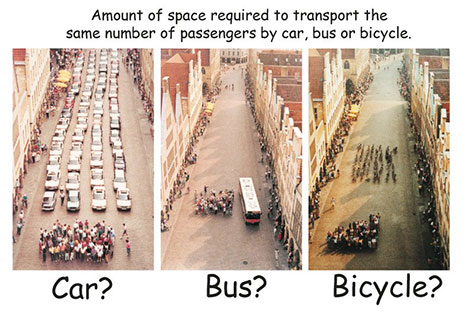
Image by Jeff Moser on flickr

Tell County Leaders We Need a Real Plan

Prince George's County's response to SafeTrack thus far has been abysmal. DPW&T has not even begun to think seriously about how it could actually help solve this transportation dilemma. They have essentially thrown their collective hands in the air and told county residents, "Good luck with that."

And instead of holding his administrative heads accountable and demanding more from DPW&T, County Executive Baker has been equally dismissive and unhelpful, telling residents they should "be proactive in seeking alternative transportation solutions," all while taking no responsibility for providing any real assistance to the constituents he is charged with leading.

There is still time for County Executive Baker and DPW&T to come up with real and workable solutions to avoid this looming transportation crisis. The public should make every effort to encourage them to do so. You can help by emailing them directly with your concerns and/or participating in the Coalition for Smarter Growth's SafeTrack email action alert.

► UPDATE (6/4/2016): After receiving some pointed inquiries from the media in the wake of this post, Prince George's officials are beginning to rethink their original (non-)response to SafeTrack. Take a look at this report from NBC Washington's Prince George's Bureau Chief Tracee Wilkins.

Monday, December 10, 2012

Is "Too Arlington" a Bad Thing in Prince George's?

This past Tuesday, the outgoing vice chair of the Prince George’s County Council, Eric Olson (D3-College Park), failed to receive the support of his colleagues to become council chair in 2013. One longtime developer lawyer in the county, AndrĂ© Gingles, posited that Olson didn’t get the job because he might be a bit “too Arlington” for Prince George’s. What’s that supposed to mean? Is that supposed to be some type of slur?

Olson, a well-known progressive smart growth and environmental advocate on the council, had been elected by his colleagues as vice chair for two years in a row. But in a surprise move, the council bypassed him for the top spot in 2013 and instead reelected its current chair, Andrea Harrison (D5-Springdale). The council also stripped Olson of the vice chairmanship and replaced him with council member Obie Patterson (D8-Fort Washington).

Harrison, who had previously pledged her support to Olson for the chairmanship, reversed course, agreed to allow her name to be placed back in the running, and then cast the deciding vote in favor of herself. As Harrison herself acknowledged to the Washington Post, the circumstances of her reelection to the chairmanship were “not comfortable.”

Through a spokesperson, county executive Rushern Baker eschewed any role in the thwarting Olson’s election to the council chair position. However, the Post reports that Baker did show up in the council chambers shortly before the vote was cast and declared, “We are moving in the right direction, we are taking Prince George’s County in the direction it needs to go .?.?. because of [Harrison’s] leadership and [her] work.”

So what is it about Harrison’s leadership and work style that arguably makes her not “too Arlington”? Or, perhaps better stated, what is it about Olson’s perceived leadership and work style that arguably makes him “too Arlington” for Prince George’s?

Well, we know that Harrison and new council vice chair Obie Patterson are both reliable supporters of the current county executive, Rushern Baker, and his largely suburban-oriented economic development agenda. Olson, by contrast, has opposed certain development projects supported by Baker, such as the controversial rezoning of the Cafritz property—a vacant, wooded formerly single-family residential-zoned parcel in Riverdale Park that is outside of the half-mile pedestrian zone of any existing Metro station or any planned MARC station.

Might Olson’s approach to land use and economic development issues be what’s “too Arlington” for his colleagues on the council and/or to County Executive Baker?

Prince George’s Should Learn From Arlington’s Smart Growth Focus

The 2002 EPA national award winner for overall excellence in smart growth, Arlington County, Virginia, is a proven leader in transit oriented development and environmental sustainability. Whether measured by housing units, jobs, retail and office space, economics, crime, or other general “livability” factors, Arlington stacks up quite favorably in the metropolitan Washington region.

Arlington’s economic development strategy over the past 40 years has been inexorably linked to its two Metro station corridors—the Orange Line’s Rosslyn-Ballston corridor and the Blue and Yellow Lines’ Pentagon/Crystal City corridor. Major employment centers and higher density residential and retail development were directed toward “urban villages” located around 7 of the county’s 10 stations: Rosslyn, Courthouse, Clarendon, Virginia Square, Ballston, Pentagon City, and Crystal City. (Arlington’s other three stations—Arlington Cemetery, Pentagon, and Reagan National Airport—have other dedicated uses.) Arlington also prioritized reinvestment in its existing residential communities ahead of creating new sprawl developments on previously undeveloped land.

Sadly, Prince George’s County has not followed Arlington’s path to success. The county has 15 Metro stations—the largest number of any jurisdiction outside of the District Columbia. With 2,500 acres of developable land within a half-mile of those stations, county planners acknowledge that Prince George’s “is uniquely situated in the Washington region to take advantage of the regional interest in TOD.”

Yet, while county leaders continue to pay lip service to the idea of transit-oriented development, they actively support development strategies that are directly contrary to that idea. Virtually all of Prince George’s County’s Metro stations remain undeveloped or underdeveloped. At the same time, county leaders continue to push outside-the-Beltway suburban sprawl strategies, like the town-less “town center” projects at Konterra, Westphalia, and Woodmore. And rather than reinvesting in its existing residential communities inside the Beltway, the county breaks its own rules to approve oversized greenfield projects like the Cafritz property.

Thus far, there has simply been no commitment on the part of Prince George’s officials to the smart growth and TOD concepts that have secured Arlington’s prosperity over the past few generations. And the comparative demographics show the troublesome results of that lack of commitment: Prince George’s lags behind Arlington in nearly every category.  

FBI Headquarters and Regional Hospital Planning Typify Prince George’s Haphazard Development Strategy

More recently, we’ve see other examples of the county’s unfocused approach to TOD in the ongoing discussions as to where the new FBI headquarters and regional medical center campuses will be located. I argued nearly a year ago that the county needed to be more nimble if it wanted to land the FBI. After identifying the five available Metro station sites (i.e., Branch Avenue, Largo Town Center, Morgan Boulevard, New Carrollton, and Greenbelt) that would meet the federal government’s requirements for the new building, I recommended Morgan Boulevard as the most ideal site. Indeed, the Morgan Boulevard station area could accommodate both the new regional medical hospital and the FBI headquarters.

The county still has yet to publicize or lobby for a particular site preference for the FBI building or the new hospital. However, despite the many transit-oriented development opportunities existing around Metro stations, the current buzz appears to favor the nearly-abandoned Landover Mall site for one or both projects. Like the Cafritz property, the mall site is outside of the pedestrian zone of any Metro station and will therefore likely encourage more single-occupancy automobile travel.

Arlington County would never have considered a development strategy that placed some of its largest employment centers and highest quality jobs away from Metro. Why? Because Arlington recognizes that successful planning requires strategic leveraging of Metro’s premier regional rail transit system. As David Alpert recently argued, when deciding where to locate a major job-and customer/patient- generating public facility such as a regional medical center, the list should start and stop with Metro.  

Prince George’s Shouldn’t Fear Being “Too Arlington”

If Eric Olson was passed over for chair of the Prince George’s County Council because of a fear that he would be “too Arlington,” that is truly regrettable. Most in the region would readily agree that, as compared to Prince George’s, Arlington County government is better managed and run, less corrupt, more focused on smart growth and transit-oriented development, better at managing the public’s finances, and overall more successful in providing a high quality of life to its citizens.

The truth is that the Prince George’s County’s government could stand to become “more Arlington” in its outlook and in its approach to smart growth and transit-oriented development. Because—let’s face it—“keeping it [real] Prince George’s” hasn’t exactly gotten us where we need to be.


(A version of this article originally appeared on Greater Greater Washington on December 10, 2012.)